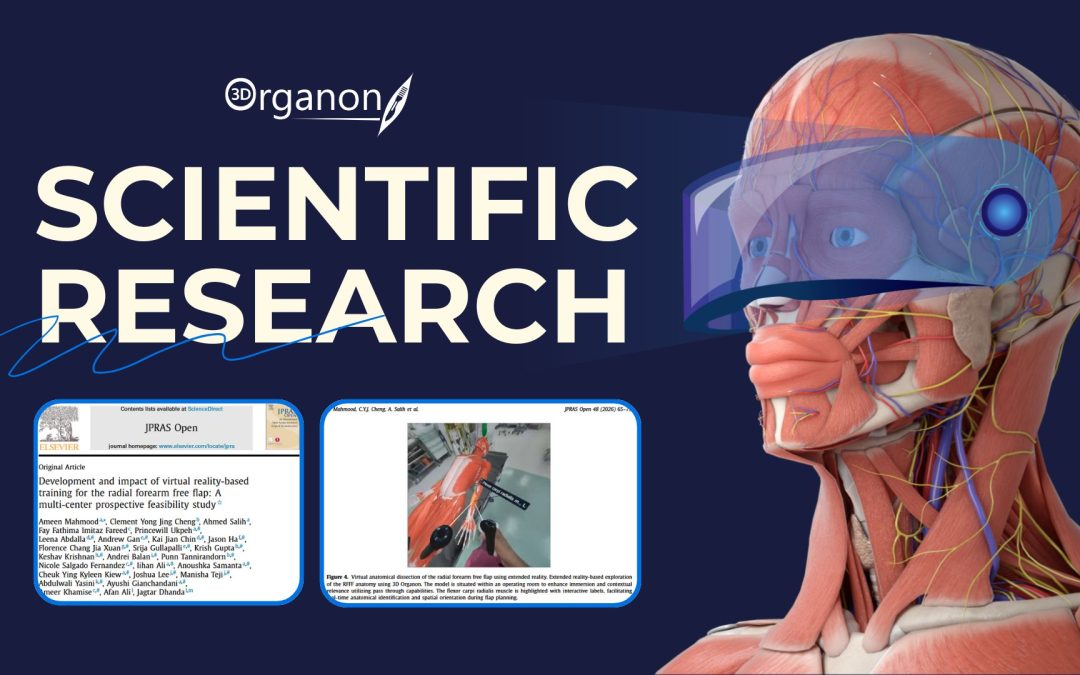
A groundbreaking study led by Ameen Mahmood titled Development and Impact of VR-Based Training for the Radial Forearm Free Flap: A Multi-Center Prospective Feasibility Study, haw demonstrated how virtual reality (VR) can reshape the future of surgical education, especially for complex reconstructive procedures. The research centers on the radial forearm free flap (RFFF); a demanding microsurgical operation that many medical students and early trainees seldom have the opportunity to observe in theatre.
Using the VRiMS teaching module and the 3D Organon platform, the team developed a fully immersive educational experience. The module integrates a 360° step-by-step procedural simulation with interactive 3D anatomical exploration, allowing learners to study the operation in unprecedented detail.
The program was rolled out across ten UK medical schools and one NHS trust, engaging 141 participants, most of whom had never previously witnessed an RFFF. Following a single 60-minute workshop, learners showed significant gains in procedural confidence and anatomical understanding, with the greatest improvements seen among pre-clinical and early-stage trainees. Participants praised the module’s clarity, realism and educational value.
These findings suggest that VR platforms such as 3D Organon offer a scalable, high-quality supplement to traditional surgical training. By mitigating barriers like limited theatre access and inconsistent supervision, virtual reality becomes a key tool in preparing the next generation of surgeons for complex operative practice.
Looking forward to continuing to improve the future of medical education!
For any inquiries, contact [email protected]