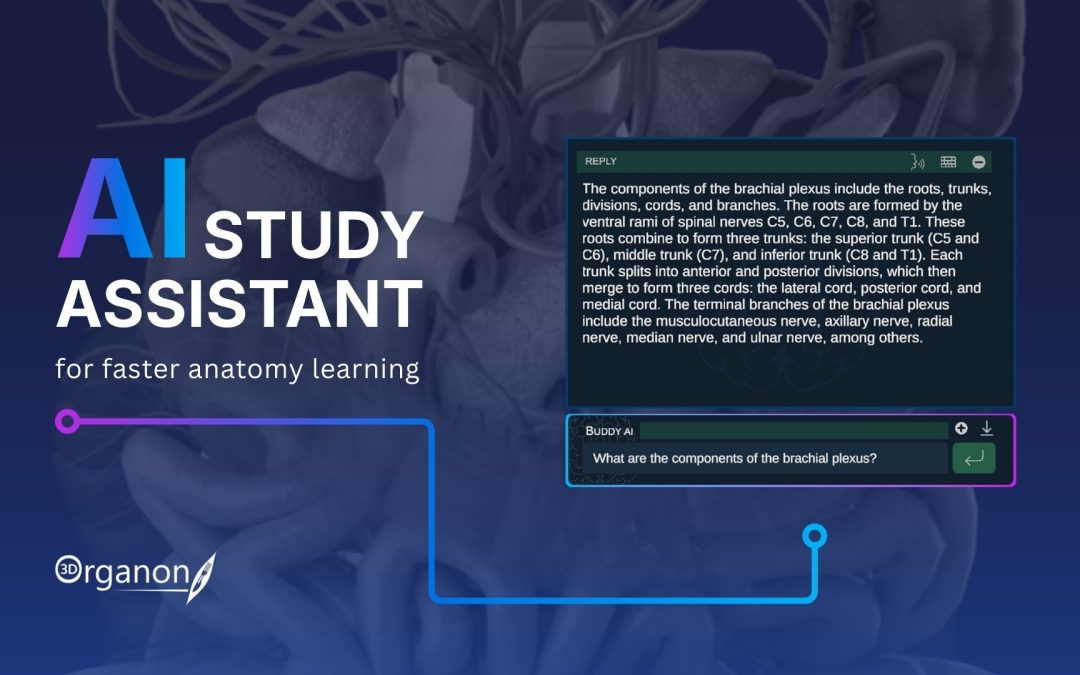
Anatomy has long been considered one of the most demanding subjects in medical and health-science education. The sheer volume of structures, complex terminology, and the need to understand three-dimensional relationships can quickly become overwhelming. While digital anatomy platforms have improved visualization, the addition of an AI-Assistant in anatomy learning, within 3D Organon introduces a new dimension to how students and professionals learn, review, and apply anatomical knowledge.
Guided Learning Instead of Endless Searching
Traditional anatomy study often involves moving between textbooks, lecture slides, atlases, and various online resources. This fragmented approach consumes time and increases cognitive load. The AI-Assistant streamlines this process by acting as an on-demand academic guide within the learning environment.
Instead of searching broadly, learners can ask focused questions about a specific structure or region. The AI helps explain what the structure is, how it is organized, and why it matters. At the same time, 3D Organon allows the learner to see that structure in accurate three-dimensional detail, whether through immersive VR exploration or on a standard screen. This combination connects verbal explanation with spatial understanding in a way that traditional resources cannot easily achieve.
Supporting Scientifically Grounded Understanding
A major challenge in modern education is not access to information, but filtering it. Students often encounter inconsistent terminology or varying levels of depth when consulting multiple sources. The AI-Assistant helps maintain a more academically grounded learning experience by providing structured anatomical explanations that align with medical education standards.
Learners can explore not only what a structure looks like, but also its components, functions, relationships to nearby organs, and clinical relevance. This supports a more complete and clinically meaningful understanding of anatomy rather than isolated memorization.
Turning Exploration Into Organized Knowledge
Seeing anatomy in 3D is powerful, but learning is strengthened when information is organized and reviewed. The AI-Assistant helps transform exploration into structured knowledge by summarizing key concepts, clarifying relationships between structures, and reinforcing important functional and clinical connections.
As learners interact with anatomical models in 3D Organon, they can simultaneously build clear mental frameworks of how structures relate to one another. This integration of visual and conceptual learning improves retention and makes later recall more intuitive, particularly in clinical contexts where spatial reasoning is essential.
Encouraging Clinical Thinking Early
Anatomy is the foundation of clinical practice, yet students often struggle to connect structural details with real-world application. The AI-Assistant encourages deeper inquiry by helping learners explore what happens when structures are injured, compressed, or diseased, and why anatomical relationships matter in diagnosis and treatment.
When these discussions are paired with fully interactive models, learners begin to think beyond labels and toward functional and clinical understanding. This shift from memorization to reasoning is one of the most important steps in medical education.
A More Efficient and Accessible Learning Workflow
By combining intelligent guidance with advanced visualization, the 3D Organon AI-Assistant helps reduce cognitive overload and makes study time more effective. Learners spend less time searching for reliable explanations and more time actively engaging with the material. Whether used in a VR lab, a classroom, or on a personal laptop, the system supports a focused and efficient workflow that adapts to different learning environments.
Ready to start your immersive medical education journey? Contact: [email protected]